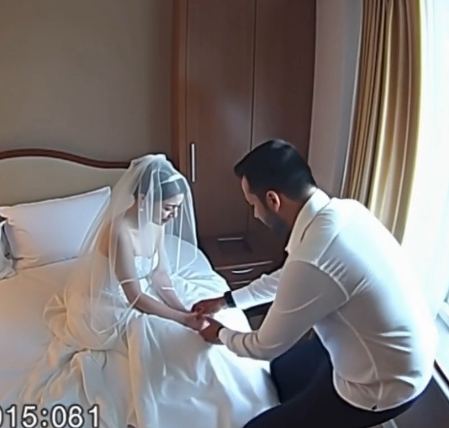
 “Lily, I’m truly sorry you had to discover it this way.” His voice, usually so poised, trembled slightly. “I never wanted this for you. But my parents… they insisted. They believe in appearances more than anything else, and I… I couldn’t defy them.”
For a moment, I stood there, stunned. The reality of the situation sank in slowly, each revelation a heavier weight upon my chest. I had married a man I barely knew, to escape poverty and help my mother, but in doing so, I had walked blindly into a world of secrets and facades.
I looked at Michael, the man who was now my husband, and saw not only a stranger but also a fellow prisoner in a gilded cage. His eyes, though distant, mirrored my own fears and regrets. We were two souls bound by circumstance, not love.
“What happens now?” I asked, my voice barely audible over the drumming of my heart.
Michael sighed deeply, the sound filled with years of silent suffering. “We live our lives as best as we can. The villa is yours, as promised. You’re free to live there, to find solace away from all this… charade. I know this isn’t what you wanted, and you deserve so much more.”
His words were sincere, yet they offered little comfort. “And you?” I asked hesitantly. “What about you, Michael?”
He leaned back, staring at the ceiling as if seeking answers among invisible constellations. “I will continue my role in the family business, keep up appearances. Perhaps someday, things will change. But for now, we must play our parts.”
In that moment, I realized that our marriage was a bond forged not by love, but by mutual necessity. We were both trapped by expectations, bound by decisions we hadn’t fully understood. But perhaps, in this shared burden, there was a chance for an unexpected alliance, a partnership born from understanding and respect rather than affection.
The following weeks were a whirlwind of adjustments. I moved into the villa, a breathtaking sanctuary by Lake Tahoe, its beauty a stark contrast to the emptiness it symbolized. I visited my mother often, ensuring she received the care she needed, and in her eyes, saw hope—a hope that made every sacrifice worthwhile.
Michael and I fell into a routine; our interactions polite, our conversations guarded, yet gradually, a fragile friendship began to blossom. We learned to appreciate each other’s company, finding comfort in shared silences and occasional laughter.
Though our marriage lacked the passion and romance I once envisioned, it was built on a foundation of unspoken understanding and quiet resilience. We were two people navigating a world of expectations, finding solace in the knowledge that we were not alone.
As I stood by the lake one evening, watching the sun dip below the horizon, I realized that life, though unpredictable and often unfair, had led me here. I had gained a husband, not in the traditional sense, but a companion in adversity. And perhaps, in time, that would be enough.